Can't Find Titanium in DSP? Here's How to Get It (And Bring It Home)
Your starter planet has zero titanium. Here's how to find it, mine it, fly it home, and automate the loop with ILS.
Your starter planet has no titanium.
That's not a bug. It's not bad luck. It's literally how the game works. The devs designed it this way to force you to figure out interplanetary travel.
Here's the quickest way to get titanium and why you shouldn't panic.
Step 1: Find Your Titanium Planet
Open your star map (M key). Look at the other planets in your starting system. One of them will have titanium veins. In the default cluster, your starter planet orbits the sun with two more planets — the one closer to the sun usually has titanium. Sometimes both do.
Can't find any titanium at all in your system? Check the big rocks on your starter planet. Some of the tall boulders drop titanium when mined. Not enough for a factory, but enough to build your first logistics tower.
It's a hard rule. If you spent 2 hours searching your home planet — stop. You're not missing anything. Go to space.
Step 2: Fly to That Planet
Before you leave:
- Equip at least 100 coal and 50 wood in your inventory (for emergency energy during the flight)
- Research Drive Engine 2 (faster space flight)
- Build at least 50 foundation (trust me)
To fly between planets: Press space to launch upward. Keep holding space to gain altitude. Once you leave the atmosphere, aim toward your target planet and hold SHIFT to accelerate. You'll see a “Warp” indicator when you're far enough out — hit SHIFT again to warp.
The flight takes about 30 seconds at warp speed. If you run out of energy mid-flight, you'll drift in space. You won't die — you'll just float until you log off. Restart your save or wait.
️ Step 3-5: The Full Titanium Workflow
Land on the titanium planet. You'll see blue-ish rock veins. Drop miners. Collect Silicon too.
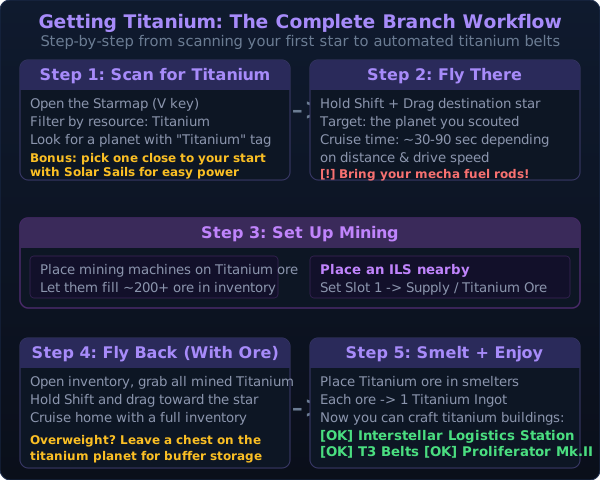
Quick notes on the process:
- Each inventory slot holds 100 titanium. With full cargo upgrade ≈ 500-800 per trip
- While mining, throw down a small power setup (solar or wind) — don't drag fuel rods
- Once you have ILS + Warpers, the manual trips stop forever
You need Green Science unlocked first. If you're not there yet, keep doing manual flights until you can research warpers. Each manual trip buys you a little more time.
Titanium pairs naturally with silicon on the same planet. Both are needed for advanced production chains - our Smelting Array Guide covers the optimal smelter ratios for titanium and silicon columns so you can process both ores efficiently on the mining planet.
Once you have Green Science, automate the loop:
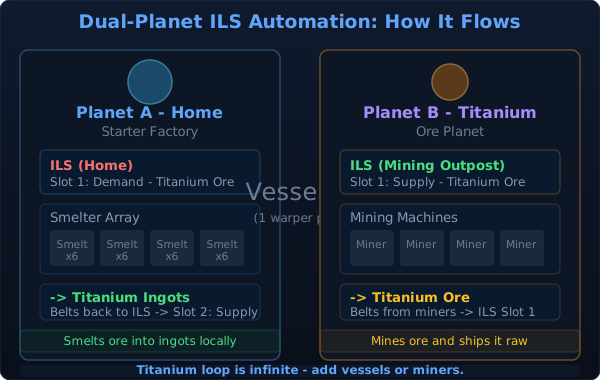
Setup checklist:
- Home planet ILS → Demand / Titanium Ore
- Titanium planet ILS → Supply / Titanium Ore
- Both ILS need Space Warpers in Slot 4
- Both ILS need power (~10 MW minimum)
- Belts from miners → ILS on titanium side
- Belts from ILS → Smelters on home side
The payoff: Once this loop starts, titanium is infinite. Every time you add another miner, your home factory gets more ore automatically.
Quick Reference
| Goal | What To Do |
|---|---|
| Find titanium | Check other planets in your system (star map → M) |
| Manual trip | Fly with coal + wood, mine blue rocks, fly back |
| Carry more | Upgrade Icarus cargo slots (research) |
| Automate it | Build ILS on both planets + supply + demand |
| Need warpers? | Research Green Science first |
The Truth About Titanium
DSP doesn't want you sitting on one planet forever. The game's whole point is expansion — building factories on multiple worlds and connecting them. Titanium is the game's way of teaching you that.
One manual trip is all it takes. After that, logistics handles everything.
Once you have a steady titanium supply, the next material bottleneck players hit is typically Yellow Science slowdown from oil processing inefficiency. Our Yellow Science guide explains the refined oil and hydrogen balance needed to keep production running.