DSP Solar Sails & Ray Receivers: Complete Endgame Power Guide
Build and optimize Solar Sails and Ray Receivers in Dyson Sphere Program. Step-by-step orbit management, power scaling, and sail deployment strategies for late-game energy.
You've got a handful of coal power plants. Maybe you've built a wind farm or twelve. You're researching toward the stars — literally — and then it hits you: the Dyson sphere isn't just the goal, it's the power solution. To get there, you need Solar Sails and Ray Receivers working in tandem.
One launches into orbit and reflects stellar radiation. The other catches that energy and converts it into usable power for your planet.
This guide walks you through how both systems actually work, how to deploy your first stable sail orbit, scale up Ray Receiver arrays, and keep the whole thing running without your grid blacking out mid-expansion.
Important note: Game balance numbers below reflect DSP v0.10 (current Early Access). Check dyson-calculator.com for live production ratios.
How Solar Sails and Ray Receivers Work
These are two distinct buildings that form a paired system.
Solar Sail is a small, passive object that orbits your star. It has no inventory, no fuel cost, and no power draw. Its only job is to reflect stellar radiation outward.
Ray Receiver is a planetary building. Placed on any planet in the same system as your sails, it absorbs reflected radiation and converts it into energy.
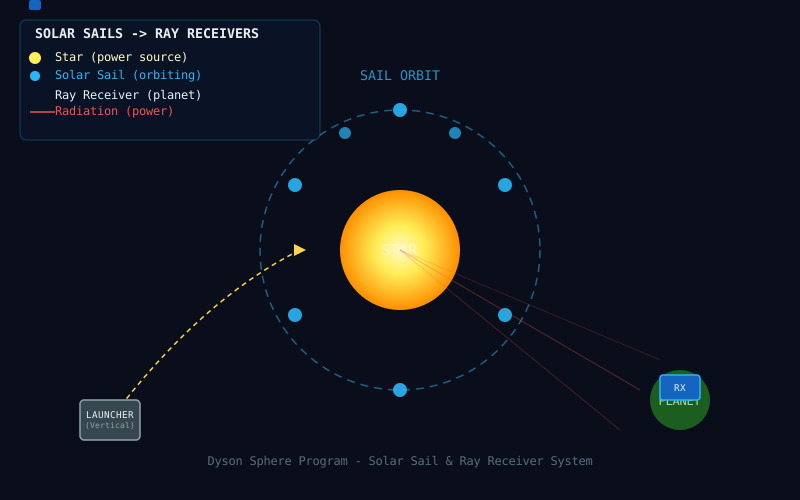
The two buildings are not optional. Sail without receivers and you're just lighting up empty space. Receivers without sails: zero input, zero output.
Step 1: Unlock and Build Vertical Launchers
Before anything enters orbit, you need the Vertical Launcher — unlocked at the Photon Network technology tier.
What you'll need to make one Solar Sail:
 Graphene
 Solar sail
Graphene comes from Coal + Oil in a Refining chain, or from Fire Ice on cold planets.
Launcher placement: Vertical Launchers are placed on any planet's surface, aimed at the local star. They don't need line-of-sight — the sail trajectory is calculated automatically.
Launcher specs (v0.10):
- Sail launch rate: 1 sail per 0.5 seconds
- Buffer capacity: 30 sails
- Power draw: 240 kW during launch
Keep a stack of Solar Sails in the launcher's inventory. Set up an Interstellar Logistics Station (ILS) nearby to auto-replenish the sail buffer.
Step 2: Launch Your First Sail Orbit
The key concept: orbit is not automatic. Sails need to be launched in a stable pattern to maintain a coherent shell.
The Manual Approach (for your first test)
- Place a Vertical Launcher on your home planet
- Manually load 6–10 Solar Sails into the launcher
- Click the launcher and set it to Auto-Launch
- Watch the orbital view — sails appear as small blue dots circling the star
- Place a Ray Receiver on the same planet
- The receiver starts collecting from whatever sails are in orbit
The Stable Orbit Threshold
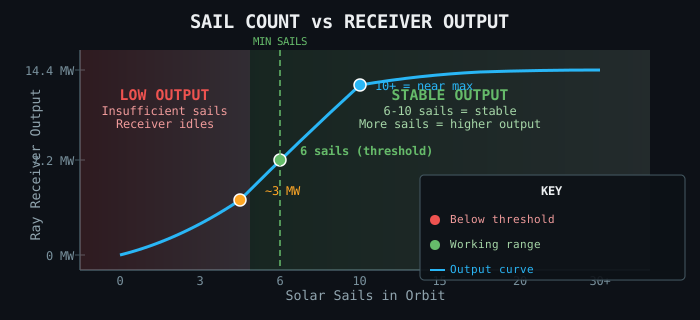
A "working" sail network for one Ray Receiver needs roughly 6–10 sails in orbit. Below that threshold, the receiver idles. Above it, output climbs until it hits its per-receiver cap.
Step 3: Build and Scale Ray Receivers
Ray Receivers are the power collection layer. A single receiver is never enough for late-game grids — you'll need an array.
Receiver Placement Rules
- Must be placed on a planet — not in space
- Must be in the same star system as your active sail orbit
- No line-of-sight requirement — radiation travels through space
- Receivers can be planet-wide; they don't interfere with each other
Energy vs. Photon Mode
Right-click a placed Ray Receiver to toggle between two modes:
Energy Mode feeds 14.4 MW directly into your power grid (at full capacity).
Photon Mode outputs Photonic Cells at a rate of 1 per ~1.44 seconds. Photonic Cells feed into:
- Solar Fusion (produces Hydrogen and Deuterium)
- Adv. Refining chains
- Quantum Chip production (endgame)
Scaling the Array
One Ray Receiver saturates at its output cap. To scale:
Solar sail Ray receiver
The ratio to aim for: roughly 1 Ray Receiver per 6–8 Solar Sails in orbit. Overshoot on sails — it's better to have more radiation than receivers can absorb than to starve them.
Step 4: Automate Sail Replenishment
Manual sail loading is a beginner trap. Here's how to automate the whole system.
The ILS + Launcher Loop
- Place an ILS near your Vertical Launcher
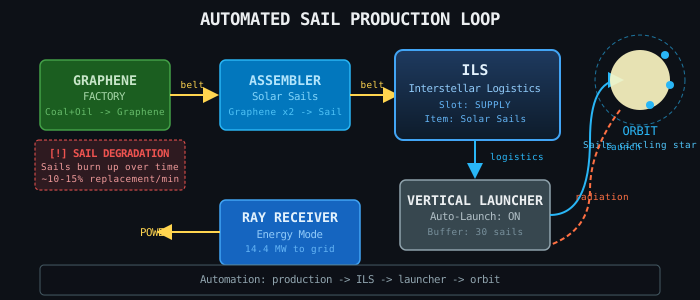
- Set the ILS to supply Solar Sails
- Set the Launcher to Auto-Launch
Sail Replenishment Logic
Sails degrade over time. They exit orbit and burn up — the exact degradation rate depends on your star type. Budget for roughly 10–15% replenishment per minute.
The practical fix: keep your sail production running continuously. If your launcher's auto-replenishment is active and your graphene supply is steady, degraded sails are naturally replaced.
Backup Power
Ray Receivers shut down if your grid power hits zero. If a sail shortage causes a receiver blackout, your grid loses power, which can cascade into production shutdowns. Always maintain a small coal or thermal backup for grid stability while transitioning to solar.
Late-Game Solar Sail Shells
The name of the endgame is the Dyson sphere — a full shell of Solar Sails surrounding your star.
The concept: instead of a handful of sails, you're launching thousands — enough to form a continuous shell. This enables truly massive power generation, the kind that fuels endgame production chains like Quantum Chips and Universe Matrix.
Late-game sail shell tips:
- Build multiple Vertical Launchers on multiple planets
- Use Planetary Logistics to distribute sail production
- Ray Receivers on inner planets collect more efficiently
- A well-configured ILS network is critical — see our ILS Setup Guide
For powering through the transition, our Power Fix Guide covers managing grid stability as you scale from coal to solar.
Quick Reference
| Building | Mode | Output |
|---|---|---|
| Ray Receiver | Energy | 14.4 MW (at full sail network) |
| Ray Receiver | Photon | ~1 Photonic Cell / 1.44s |
| Vertical Launcher | — | 1 Sail / 0.5s, 30-sail buffer |
| Solar Sail | Orbital | Reflects stellar radiation (passive) |
Recipe: Solar Sail
GrapheneSolar sailRecipe: Graphene (from Coal + Oil Refining)
 Coal
Coal Refined oilGraphene
Key unlocks: Photon Network tech → Vertical Launcher + Ray Receiver
Bottom Line
Solar Sails and Ray Receivers are the bridge between planetary power and stellar-scale energy. Launch your first sails, get a single Ray Receiver running in Energy mode, then automate the replenishment loop with an ILS. From there, scale by adding more sails and more receivers — and switch a few receivers to Photon mode when you need Photonic Cells for late-game production.
The endgame sail shell is a different beast — but everything you need for it is covered by mastering the basics first.