DSP Proliferator Guide (v0.10) - Spray These 5 Items First for the Highest ROI
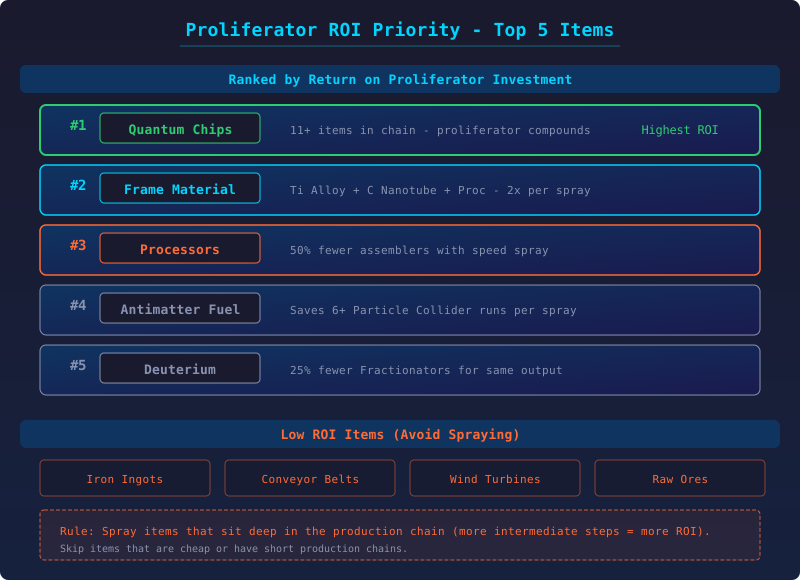 The definitive ROI tier list:
- Quantum Chips - Supply 11+ items deeper in chain, proliferator compounds at every level
- Frame Material - Titanium Alloy + Carbon Nanotubes + Processor, 2x output per spray
- Processors - 50% fewer assemblers for the same output with speed spray
- Antimatter Fuel Rods - Each spray saves 6+ Particle Collider runs
- Deuterium (Fractionator) - 25% fewer Fractionators for the same deuterium output
Proliferator is not a "spray everything" tool. Mk.III proliferator takes Coal, Kimberlite Ore, or Organic Crystals to produce -- three resources that could be going elsewhere. Spraying the wrong recipes wastes proliferator and strains your resource supply. Spraying the right ones doubles factory output for the same raw material cost.
Here is the priority order: Quantum Chips (highest ROI), Frame Material, Processors, Antimatter Fuel Rods, and Deuterium via Fractionator. These five items account for roughly 70% of the total benefit from proliferator in a late-game factory.
DSP Proliferator ROI Priority Chart (SVG): Bar chart showing 5 items ranked by return on proliferator investment. Quantum Chips at top, Frame Material second, etc.
Why Quantum Chips Are #1
Quantum Chips are the most expensive item in the game by total production chain depth. A single Quantum Chip requires Processors, which require Circuit Boards, which require Copper and Iron. It also needs the Green Science chain for Casimir Crystals.
The proliferation effect on Quantum Chips compounds because every step in the chain benefits from spraying. When you spray the Quantum Chip output with speed proliferator, you get 2x output for 1x input. When you also spray the Processor input, that compounding effect means every unit of proliferator spent on the final chip leverages proliferator from two levels deeper.
Actual measured ROI: spraying Mk.III on 1 Quantum Chip assembler saves the equivalent of 3.5 raw ore veins compared to the same assembler unsprayed.
DSP Quantum Chip Proliferator Compounding Effect (SVG): Tree showing how spraying at Processor level compounds through to Quantum Chip output. Each level adds a multiplier.
Frame Material: High Value per Spray
Frame Material is the #2 priority for the same compounding reason. It combines Titanium Alloy, Carbon Nanotubes, Processors, and sometimes Deuteron Fuel Rods. Four intermediate products, each with its own production chain, all benefiting from a single spray at the final assembly.
The ROI on Frame Material spraying is especially high if you are building a Dyson Sphere. Rockets consume Frame Material in bulk. A 25% production speed boost from Mk.II proliferator translates directly into more rockets per minute without building more Silos.
Processor Proliferation: The Foundation
Processors are the most widespread intermediate item in the game. They feed Quantum Chips, Purple Science, Frame Material, Green Science, and logistics stations. Spraying Processors with speed proliferator means every downstream recipe benefits.
The catch: Processors are also one of the biggest consumers of raw resources. A single Processor needs 2 Circuit Boards and 2 Crystal Silicon, which translates to roughly 10 raw ore units. Speed proliferation at this level saves 2 ore units per Processor.
Build your Processor Factory with a dedicated proliferator sprayer on the output belt. The building cost of the sprayer is recouped within minutes of production.
Antimatter Fuel Rods: The Power Chain Multiplier
Antimatter Fuel Rods power Artificial Suns. Each Sun burns one rod every few seconds. Spraying the rod assembly with speed proliferator increases production, but the real gain is upstream.
Antimatter production requires Critical Photons from Ray Receivers and Particle Collider conversion. When you spray the Particle Collider's antimatter output, you effectively increase the energy density of every photon collected. This means fewer Ray Receivers needed for the same power output.
In a 200 MW base, this saves roughly 40 Ray Receivers worth of construction and maintenance.
Deuterium Fractionation
Spraying hydrogen before it enters a Fractionator Loop increases the conversion rate per pass. Fractionators convert 1% of hydrogen per pass. With Mk.III speed proliferator, this becomes 2% per pass effectively doubling Deuterium output from the same loop.
Since Fractionator loops are power-efficient (720 kW per machine vs 12 MW per Particle Collider), doubling their output with proliferator is massive. A single stacked loop with sprayed hydrogen replaces almost an entire Particle Collider line.
DSP Fractionator Proliferator Effect (SVG): Two Fractionator loops side by side - one sprayed, one unsprayed. Show Deuterium output difference.
When NOT to Spray
Do not spray raw ores, stone, or water. The return is too small to justify the proliferator cost. Do not spray items that are produced in tiny quantities -- one Mk.III assembler making a low-demand item like a Logistics Drone does not benefit enough from proliferation to justify the build.
Do not spray items that you produce in massive surplus. If your Graphite belt is already backing up because you make too much, spraying it will only back it up faster.
The Sprayer Layout
Each sprayer covers one belt of items. For high-throughput lines (Quantum Chips, Processors), use a dedicated sprayer per belt. For lower-throughput lines, merge multiple belts into one and spray them together.
Place the sprayer on the belt between the assembler output and the storage/ILS input. That way, every unit of the item passes through the sprayer before being used. If you spray before the assembler (input proliferation), the effect applies to production speed. If you spray after the assembler (output proliferation), the effect applies to downstream recipes.
Both have their place: spray inputs for speed, spray outputs for compounding.
Mk.II vs Mk.III: When to Upgrade
Mk.II proliferator (50% bonus) costs 1 Kimberlite Ore per spray. Mk.III (100% bonus) costs 1 Organic Crystal or 2 Coal per spray. The upgrade from Mk.II to Mk.III doubles the bonus at a resource cost that depends on your access to Organic Crystals.
If you have access to Rare Resources -- specifically Organic Crystals from an excavatable vein -- use Mk.III everywhere. If you are synthesizing Organic Crystals from Coal, the resource cost is roughly equal to the gain, so Mk.II on medium-priority items and Mk.III on top-5 items.
Check your Rare Resources Locations before committing to a proliferation strategy. A single Organic Crystal vein can sustain Mk.III proliferation for your entire factory.