DSP Fire Ice & Deuterium: Cold Planet Refining Guide
Find and refine Fire Ice on cold planets in Dyson Sphere Program. How to extract Deuterium, manage water byproducts, and power your advanced fuel chains.
You've found a lava world or an ice giant. The stars call it a Fire Ice planet — and it's full of something that doesn't exist on temperate worlds: Deuterium. Deuterium is your path to advanced fuels, high-output Rocket Fuel, and the Yellow Science chain.
But getting it out of the ground and into your factory requires understanding a completely different logistics problem.
This guide covers finding Fire Ice planets, the extraction and refining mechanics, managing the water byproduct, and how to integrate Deuterium into your endgame production.
Finding a Fire Ice Planet
Fire Ice deposits appear on specific planet types:
- Volcanic planets
- Oceanic planets (large water/ice surfaces)
- Tundra or ice cap planets with high "cold" rating
Not every planet in a volcanic system will have Fire Ice. Check the planet's surface in the galaxy map — look for blue-white deposits in the resource overlay.
For the logistics to get off-world resources, see our Titanium Transport Guide and ILS Setup Guide.
Step 1: Extract Fire Ice
Fire Ice Extractors are the mining buildings for this resource. Unlike standard Mining Machines, they're specialized for the Fire Ice deposit type.
Extractor specs (v0.10):
- Extracts Fire Ice from deposit nodes
- Produces: Fire Ice x1 / s
- Power draw: 360 kW
Placement Strategy
Fire Ice nodes are often spread across a planet's surface rather than concentrated. Build extractors at multiple clusters.
One central Deuterium Fractionator bank can receive Fire Ice via Planetary Logistics or Interstellar Logistics for cross-system chains.
Step 2: The Deuterium Fractionator
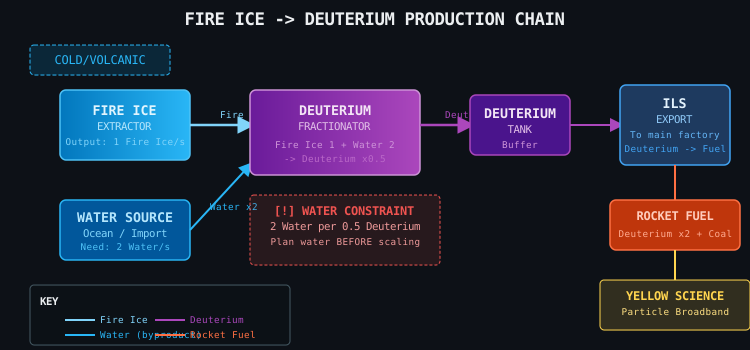
The Deuterium Fractionator converts Fire Ice into Deuterium. It requires a water input — which is where the byproduct problem starts.
Fractionator recipe:
 Fire ice
 Water
Water Deuterium
The byproduct ratio matters. For every 0.5 units of Deuterium you produce, you need 2 units of water. On a planet with limited water deposits, this becomes a bottleneck fast.
Solving the Water Problem
Water is easy on ocean planets — but scarce on volcanic worlds. Options:
- Import water via logistics from a water-rich planet in the same system. Use ILS for interplanetary transport.
- Use oceans directly — if your Fire Ice deposits are on an oceanic planet, build fractionators on the shore.
- Desalination — available in some planet biomes (research-dependent).
Water tank storage: Keep a buffer tank near your fractionators. If your water supply briefly stalls, the fractionator stops and you lose throughput.
Step 3: Using Deuterium
Deuterium isn't just a curiosity — it has serious applications in late-game production.
Rocket Fuel (Deuterium variant)
Advanced Rocket Fuel recipe uses Deuterium:
Deuterium Coal
Coal Rocket fuel
Compared to the standard refined oil recipe, the Deuterium version is more compact — no refined oil dependency — but requires a stable Fire Ice supply chain.
This is the preferred late-game fuel recipe once your Fire Ice operation is established.
Yellow Science and Advanced Research
Deuterium feeds into the Yellow Science chain — the final science tier that requires particle broadband and quantum chips.
Yellow Science unlocks:
- Full Dyson sphere shell construction
- Macro logistics network
- Endgame production structures
Step 4: Automation and Logistics Setup
The Fire Ice chain is more demanding than standard mining. Here's the layout that works:
- Fire Ice Extractors on multiple surface clusters → belts to central bank
- Central Deuterium Fractionator bank — co-located with water supply
- Water tanks at fractionator inputs — buffer against interruptions
- Water import ILS — pull water from water-rich planet if needed
- Deuterium export ILS — ship to your main production planet
Power planning: A fractionator bank of 10 units draws 3.6 MW — not trivial. Make sure your cold planet has adequate power before scaling up.
Quick Reference
| Building | Input | Output | Notes |
|---|---|---|---|
| Fire Ice Extractor | Deposit | Fire Ice x1/s | 360 kW power draw |
| Deuterium Fractionator | Fire Ice + Water x2 | Deuterium x0.5 | Water is the constraint |
| Adv. Rocket Fuel | Deuterium x2 + Coal x1 | Rocket Fuel x1 | No oil dependency |
Water ratio: 2 Water per 0.5 Deuterium. Budget water supply before scaling fractionators.
Bottom Line
Fire Ice is a planet-type-gated resource — finding the right world is half the battle. Once you've got a cold planet with Fire Ice deposits, the processing chain is straightforward: extract, fractionate, export.
The water byproduct is the real constraint — manage it with a dedicated water import route or an on-planet ocean supply before you scale up. Deuterium rockets are worth it for endgame fuel independence.
For a full production calculator covering Fire Ice chains and Deuterium ratios, see dyson-calculator.com.