DSP Late-Game Factory Expansion Guide (v0.10) - Scale From 30 to 300 Science Per Minute
Scale your Dyson Sphere Program factory from mid-game to endgame. Complete guide to transitioning from a single-planet base to a multi-planet production empire, with blueprint strategies, bus design, and logistics optimization for 300 SPM.
Scaling from 30 SPM to 300 SPM is not about building bigger factories. It is about building different factories. The single-planet approach breaks down around 60 SPM. Beyond that, you need a distributed multi-planet production network. Before scaling, make sure your smelting arrays are optimized - a single Mk.III smelting column handles 3 smelters per belt, and you will need dozens of them at scale.
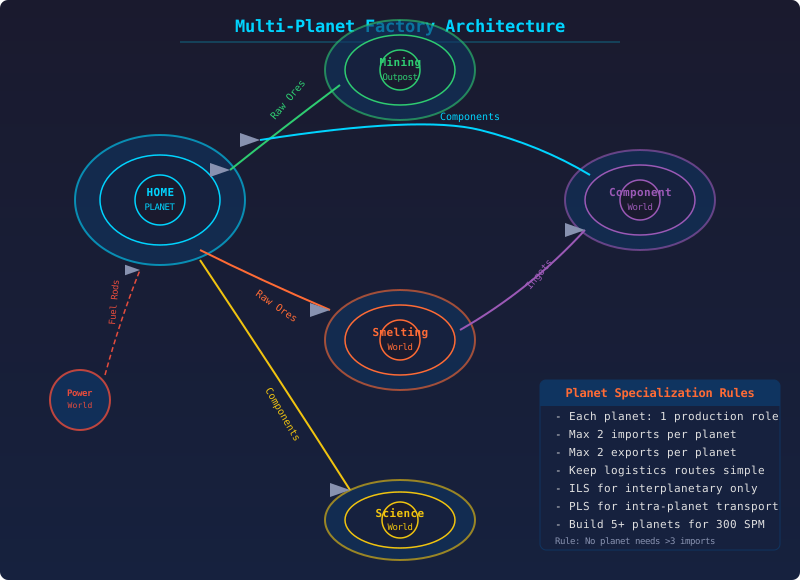
The Multi-Planet Architecture
Planet Specialization
Assign each planet a single production role:
| Planet Role | Built On | Ships Out | Ships In |
|---|---|---|---|
| Smelting World | High-ore planet | Iron, Copper, Steel, Titanium Ingots | Nothing (mine locally) |
| Component World | Any temperate planet | Processors, Circuit Boards, Magnetic Coils | Ingots from Smelting World |
| Science World | High-wind planet | Science Matrices | Components from Component World |
| Power World | Inside Dyson Sphere | Antimatter Fuel Rods | Nothing (local production) |
| Mining Outpost | Ore-rich planet | Raw ores | Warpers only |
**Rule of thumb:** If a planet needs more than 3 different imports, you are over-complicating it. Each planet should import 1-2 raw materials, process them, and export 1-2 finished products. This keeps logistics simple and vessel routes predictable.
Scaling Production Modules
Build production in identical, repeatable modules. Each module should produce exactly the amount needed for 30 SPM of one science type:
| Module | Input Belt | Output Belt | Buildings | Area |
|---|---|---|---|---|
| 30 SPM Blue | 1 Mk.I Iron + 1 Mk.I Copper + 1 Mk.I Silicon | 1 Mk.I Blue Science | 6 smelters + 3 assemblers | ~20 tiles |
| 30 SPM Red | 1 Mk.I Coal | 1 Mk.I Red Science | 3 refineries + 3 assemblers | ~15 tiles |
| 30 SPM Yellow | 1 Mk.II Oil + 1 Mk.I Iron | 1 Mk.I Yellow Science | 4 refineries + 6 assemblers | ~30 tiles |
| 30 SPM Purple | 1 Mk.II Titanium + 1 Mk.II Steel | 1 Mk.I Purple Science | 8 assemblers + 4 chem plants | ~40 tiles |
| 30 SPM Green | 2 Mk.II H2 + 1 Mk.II Graphene | 1 Mk.I Green Science | 12 assemblers + 6 colliders | ~50 tiles |
 Mkii belt
 Assembler
Build each module 10 times for 300 SPM. Place them side by side in a row, fed by a main bus of raw materials.
The Main Bus Design for 300 SPM
A main bus carries bulk raw materials past all production modules:
| Bus Lane | Material | Belt Type | Items/min |
|---|---|---|---|
| Lane 1 | Iron Ore | Mk.III (1080/min) | 720 |
| Lane 2 | Copper Ore | Mk.III | 360 |
| Lane 3 | Coal | Mk.III | 180 |
| Lane 4 | Energetic Graphite | Mk.III | 360 |
| Lane 5 | Silicon Ore | Mk.III | 180 |
| Lane 6 | Titanium Ore | Mk.III | 240 |
| Lane 7 | Steel | Mk.III | 360 |
| Lane 8 | Refined Oil | Mk.III | 240 |
Build the bus 2 tiles wide between lanes for power poles and sorters. Leave 10 tiles on each side for assembler clusters. The bus should run east-west across the planet's equator.
Blueprint Library for Rapid Expansion
Build a library of reusable blueprints:
| Blueprint | Buildings | Connectors | Purpose |
|---|---|---|---|
| 4x Smelter Array | 4 smelters | 1 input belt, 1 output belt | Ore smelting |
| 4x Assembler Block | 4 assemblers | 2 input belts, 1 output belt | Component assembly |
| 2x Chemical Plant Block | 2 chem plants | 2 input belts, 1 output belt | Chemical processing |
| ILS In/Out Hub | 1 ILS + 5 belts | 1 input tower, 1 output tower | Logistics hub |
| Power Substation | 4 fusion plants + 16 batteries | Power pole connections | Stable power supply |
Each blueprint should snap to a grid. Place them side by side to build a factory in minutes instead of hours.
Common Scaling Pitfalls
The Hydrogen Wall
At 150+ SPM, Hydrogen consumption exceeds 1000/min. No single gas giant supplies this. You need:
- 40+ orbital collectors across 3 gas giants
- A fleet of 20+ Logistics Vessels dedicated to Hydrogen transport
- Thermal power plants burning excess Hydrogen as buffer
Hydrogen backup is the most common scaling killer. When your Casimir Crystal line stalls, hydrogen backs up through oil refineries and halts everything. Our Hydrogen Backup Fix Guide covers how to build pressure relief valves into your hydrogen network before it becomes a problem.
The Mineral Depletion Cliff
At 200+ SPM, your starting planet veins deplete fast:
- Iron ore: ~8 hours per million units at 200 SPM
- Copper ore: ~10 hours per million units
- Titanium ore: ~15 hours per million units
Build off-world mining outposts on 3+ planets before hitting the depletion cliff. Use Vein Utilization research aggressively - aim for level 6 before scaling past 100 SPM.
Summary: Scaling Roadmap
| SPM Target | Planets Needed | Total Miners | Total ILS | Power Required |
|---|---|---|---|---|
| 30 SPM | 1 (starting planet) | 60 | 4 | 10 MW |
| 60 SPM | 2 (home + 1 outpost) | 120 | 10 | 30 MW |
| 120 SPM | 3 (home + 2 outposts) | 240 | 20 | 80 MW |
| 300 SPM | 5+ (distributed) | 600 | 50 | 250 MW |
At scale, logistics congestion becomes as important as production throughput. The Drone Congestion Guide explains how to cap drones per station and use priority splitters so your ILS network doesn't gridlock at 120+ SPM.
Before scaling, make sure your DSP Research Lab Guide covers your science foundation.