DSP Dyson Sphere Layer Design (v0.10) - Permanent Frame Strategy for Maximum Power Per Solar Sail
Master Dyson Sphere layer design in Dyson Sphere Program. Complete guide to frame-first strategy, orbit selection, frame geometry, node distribution, and sail-to-power efficiency ratios for endgame power.
The Dyson Sphere is the ultimate goal of DSP, but most players build it inefficiently. They launch sails into random orbits where they expire after 2 hours, wasting resources. The correct approach is frame-first: build the permanent structural frame, then let sails fill it.
Frame-First Strategy
Solar Sails launched without a frame are temporary. They expire after 1800 seconds (30 minutes) and provide no permanent structure. Sails absorbed by a Dyson Sphere frame node become permanent.
| Approach | Sail Lifespan | Material Efficiency | Power Output |
|---|---|---|---|
| Sails only (no frame) | 30 minutes | 0% (all lost) | Temporary |
| Frame first, then sails | Permanent | 100% | Permanent |
| Mixed (some frame, some free sails) | Varies | 50-70% | Semi-permanent |
Orbit Selection
The orbit radius determines power output per sail:
| Orbit Radius (AU) | Power Multiplier | Sail Count for 100 MW | Relative Cost |
|---|---|---|---|
| 0.5 | 1.4x | ~1800 | Baseline |
| 1.0 | 1.0x | ~2500 | +40% more sails |
| 1.5 | 0.7x | ~3600 | +100% more sails |
| 2.0 | 0.5x | ~5000 | +180% more sails |
 Solar sail
 Frame
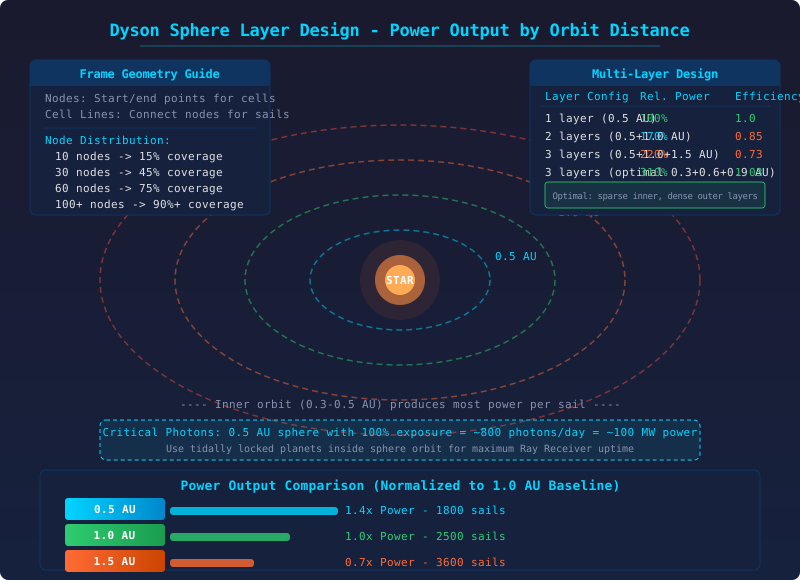
FrameThe closer to the star, the more power per sail. Build your first layer at 0.5 AU or less. The frame costs more (wider circumference = more structure points), but the sail savings pay for the extra frame material within 2 hours of operation.
**The 0.5 AU rule:** Most stars allow orbits as close as 0.2-0.3 AU. Check your star's radius in the starmap. Inner orbits pack more power density per square meter of sphere surface. A 0.3 AU sphere produces nearly 2x the power of a 1.0 AU sphere with the same sail count.
Frame Geometry
Dyson Sphere frames are built from two structural elements:
| Element | Function | Material Cost | Build Time |
|---|---|---|---|
| Node | Start/end point for cell lines | Frame Material x20 | 10s |
| Cell Line | Connects nodes, defines sail area | Frame Material x6 per segment | 5s per segment |
Node Distribution Strategy
For maximum coverage with minimum nodes:
| Node Count | Coverage | Best For |
|---|---|---|
| 10 | ~15% surface | First layer test, minimum viable sphere |
| 30 | ~45% surface | Mid-game power source |
| 60 | ~75% surface | Endgame power needs |
| 100+ | ~90%+ surface | Max power output |
Each node costs 20 Frame Material, which consumes processors at a high rate. Optimizing your processor production with quantum chip proliferation dramatically reduces the resource cost of building a full sphere. Build 30 nodes arranged in a geodesic pattern (like a soccer ball). Connect every node to its 3-5 nearest neighbors with cell lines. Complete one full layer before starting the next.
Multi-Layer Design
Building multiple layers compounds power output:
| Layers | Orbit Radii | Total Power | Total Sails | Efficiency |
|---|---|---|---|---|
| 1 | 0.5 AU | 100% | 100% | 1.0 |
| 2 | 0.5 + 1.0 AU | 170% | 200% | 0.85 |
| 3 | 0.5 + 1.0 + 1.5 AU | 220% | 300% | 0.73 |
| 3 (optimal) | 0.3 + 0.6 + 0.9 AU | 310% | 300% | 1.03 |
Critical Photon Production
The Dyson Sphere produces Critical Photons based on the total sail surface area facing the star. Each Ray Receiver:
- Produces 1 Critical Photon per 1.2s at 100% exposure
- Needs unobstructed line of sight to the sphere
- Works best on a tidally locked planet (always-facing side)
For stable power, build 20-40 Ray Receivers on the planet closest to the Dyson Sphere. Each receiver with Graviton Lenses produces ~2x the photon rate.
Ray Receiver Placement
| Placement | Uptime | Photons/Day | Power |
|---|---|---|---|
| Random planet | 30-60% | 200-400 | 25-50 MW |
| Planet inside sphere orbit | 80-100% | 600-800 | 75-100 MW |
| Tidally locked (day side) | 100% | 800-1000 | 100-125 MW |
Build your antimatter factory on the planet with the best Ray Receiver uptime. Ship Antimatter Fuel Rods via ILS to your production planets. For the full production chain from Critical Photons to a self-sustaining antimatter loop, see our DSP antimatter power guide.
New to Dyson Spheres? Start with our DSP Dyson Sphere Guide for the basics.