DSP Dyson Sphere Guide - Permanent First Layer Frame Strategy
Build your first Dyson Sphere in DSP. Step-by-step guide from solar sails to node framing to full shell. No wasted resources.
Building a Dyson Sphere is the endgame milestone in DSP. But the first attempt often fails: you launch sails, they expire, and you get zero power.
Here is the exact sequence to build a permanent, self-sustaining first layer.
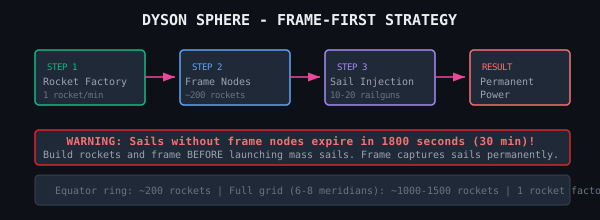
TL;DR: The 4-Step Sequence
Build rockets first, not sails. A common trap: players launch thousands of solar sails and watch them expire (they last 1800 seconds - 30 minutes). Permanent sphere requires frame nodes, which require rockets. Build a rocket factory BEFORE scaling your sail launcher.
Step 1: The Minimum Rocket Factory
Each rocket costs: 2x Quantum Chips + 2x Graviton Lenses + 2x Rocket Payload + 4x Deuterium Fuel Rods. That is a heavy production line. Build a minimum of 1 rocket per minute to start - this feeds about 6-8 railguns.
Your rocket factory needs at least:
- 2 quantum chip assemblers (fed by processors, coincident circuits, and titanium)
- 2 graviton lens assemblers (fed by processors and strange matter)
- 4 deuterium fuel rod assemblers (fed by deuterium and titanium alloy)
- 2 particle container assemblers for rocket payload (graphene + titanium)
This is around 30 buildings. Build it on your home planet or a mining world with titanium and silicon.
Step 2: Choose Your First Sphere Orbit
Open the Dyson Sphere panel (press Y). Two orbit types matter for your first build:
- Default orbit: 0 degree tilt, circular. Easiest to build. Good starting choice.
- Custom orbit: Adjustable tilt and radius. Higher radius captures more power but costs more rockets.
For your first sphere, pick the default orbit at radius 25,000 km - 35,000 km. This balances material cost with power output.
Step 3: Frame Construction Strategy
The frame is the skeleton of your sphere. You build it with rockets. Each section of frame costs rockets and produces the nodes that capture sails permanently.
Build the latitude ring first. Place a ring around the equator at 0 degrees. This is the cheapest permanent structure - only about 200 rockets for a full ring. Once the ring is up, every sail launched into the ring orbit becomes permanent.
Then add longitude lines connecting from the equator ring to each pole. Think of it as a grid: equator ring + 6-8 meridian lines. This grid structure costs roughly 1000-1500 rockets total.
Step 4: Sail Injection (After Frame Exists)
Never launch sails without an active frame node in their orbit path. Sails only become permanent when they intersect with a frame node. Without a node, they expire after 1800 seconds.
Build approximately 10-20 railguns for a starter sphere. Each gun fires about 1 sail per 2 seconds. Aim for the frame node orbit. Once you see sails attaching to the grid, you are generating permanent power.
Ray Receiver Setup
Place Ray Receivers on the planet surface and point them (press R) toward the sphere. Each receiver captures roughly 5-15 MW depending on sphere completion. You need about 20-30 receivers to notice a meaningful power boost.
Use Graviton Lenses in your receivers - they double output at the cost of one lens per 10 minutes of receiver operation. Send lenses via logistics.
Common First Sphere Mistakes
- Rocket shortage: Build buffer chests. Rocket production is slow. A buffer of 200-500 rockets lets you build frame sections without waiting for production.
- Sails before frame: Every sail launched without a frame node is wasted. Only launch sails after the first frame node is in place.
- Too small an orbit: A small orbit (under 20,000 km) means fewer frame nodes, meaning fewer sail attachment points, meaning wasted sails.
- No lens production: Graviton Lenses double receiver output. If you are making processors, make lenses too.